

In an era where customers are increasingly selective about the businesses they trust, personalization is no longer a nice-to-have. It's a baseline expectation. Customers, whether at the individual or corporate level, want to feel known, not just served. They want conversations that are relevant to them, not generic messages that are obviously being sent to thousands of people at once
The strategic challenge for many companies today is how to deliver that depth of personalization at scale. This is precisely where the synergy between WhatsApp Business API (WABA) and a CRM system becomes critical. Integrating these two platforms is one of the most relevant solutions available for connecting the world's most widely used communication channel with a comprehensive customer data foundation.
When the two work in an integrated way, they create a communication ecosystem where every customer interaction feels personal, contextual, and timely, without sacrificing operational efficiency.
What Is Hyper-Personalized Customer Interaction?
Personalization in customer service isn't a new concept. Addressing a customer by name at the start of a message, for example, is the most basic form of it. But hyper-personalization goes far deeper than that.
Hyper-personalized customer interaction means every message, notification, or conversation a customer receives is based on real data about them: their transaction history, service preferences, past interaction patterns, their current stage in the business relationship cycle, and the specific context of their most recent interaction.
In practice, it looks like this: a corporate client who asked about contract renewal two days ago receives a WhatsApp message that specifically references that conversation, offers relevant follow-up information, and is sent at the right time based on their previous response patterns. Not a generic broadcast, not a one-size-fits-all follow-up template.
Achieving this level of personalization requires two complementary elements: a communication channel flexible and personal enough to carry it, like WABA, and a rich, well-structured data source to power it, like a CRM.
The Role of WABA in the Modern Business Communication Ecosystem
WABA, or WhatsApp Business API, is the enterprise version of WhatsApp, designed specifically for large-scale business communication needs. Unlike the standard WhatsApp Business app suited to small businesses with limited interaction volumes, WABA enables companies to manage thousands of simultaneous conversations, automate message delivery, and integrate WhatsApp communication with other existing technology platforms.
From a personalization standpoint, WABA offers advantages that are difficult for other channels to match. WhatsApp is already deeply familiar and used daily by virtually every customer segment. Messages arriving through WhatsApp feel more personal than email, more convenient than phone calls, and richer in context than SMS.
When WABA is used as the primary communication channel in a service strategy, businesses gain access to a channel that's already in the customer's hands, with message read rates significantly higher than conventional channels.
The Role of CRM as the Data Foundation for Personalization
If WABA is the communication channel, CRM is the brain behind it. A CRM system stores and manages all relevant data about every customer: who they are, what they've purchased, what they've asked about, how they typically respond, and where they currently stand in the business relationship cycle.
This data is the raw material of personalization. Without a CRM populated with accurate, structured data, no matter how sophisticated the communication platform, messages sent will never feel truly personal because there's no data foundation supporting them.
A good CRM also isn't just a data repository. It's a system that updates automatically every time a new interaction occurs, so every customer profile always reflects the most current and relevant state of that relationship.
How WABA and CRM Work Together
When WABA and CRM are integrated, the result is a two-way, real-time, automatic data exchange. Here's how this synergy plays out in real scenarios.
Automated Messaging Based on Customer Data
With WABA and CRM integrated, businesses can configure automatic WhatsApp message delivery triggered by data signals in the CRM. For example, when a client's contract status in the CRM shows it's expiring within 30 days, the system automatically sends a WhatsApp message with relevant renewal information, complete with the client's name, specific contract details, and the right contact person to follow up with.
This isn't a mass broadcast filtered roughly by segment. It's genuinely personal communication because it's built on data specific to that client.
Conversation Context That's Always Preserved
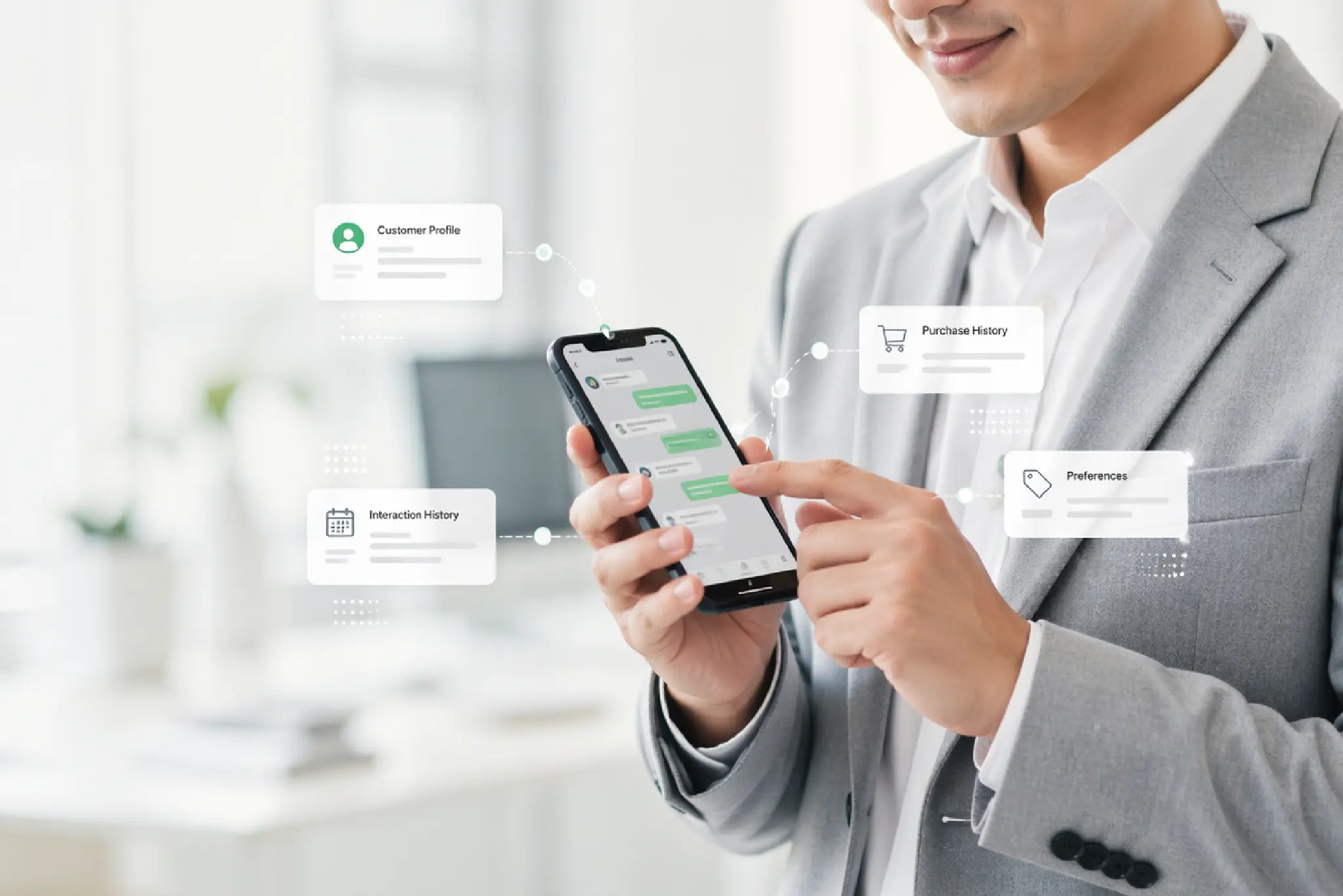
When a customer initiates a conversation through WABA, the handling agent immediately gets access to the customer's complete CRM profile, including transaction history, previous interactions, service preferences, and the current status of the business relationship.
This means agents don't need to start from scratch in every conversation. They can get straight to what the customer actually needs without asking basic questions that the existing data already answers. The result is a conversation that feels more efficient for the customer and more productive for the agent.
Automatic CRM Updates from Every Interaction
Every conversation that takes place through WABA is automatically recorded to the customer's profile in the CRM. Topics discussed, resolutions provided, preferences revealed through the conversation: all of it becomes part of a customer data profile that grows richer with every interaction.
This creates a continuously improving cycle. The more interactions occur, the richer the available data, and the more personalized the communication that can be generated from it.
Precise Segmentation for Relevant Communication
WABA and CRM integration enables businesses to segment customers with far greater precision before sending any message. Not just segmentation by industry or company size, but by actual behavior, stage in the service lifecycle, engagement level, and various data combinations available in the CRM.
The result is that messages sent through WABA are consistently relevant to the recipient, not just less irrelevant to some of them.
Benefits of WABA and CRM Synergy for B2B
Higher Customer Response Rates
Consistently personal and relevant messages generate higher response rates than generic ones. In a B2B context, where every communication competes for the attention of busy decision-makers, message relevance is what determines whether a message gets read and acted on, or simply ignored.
Faster Service Cycles
When agents have direct access to complete customer data from the CRM the moment a conversation comes in through WABA, the time needed to understand context and provide the right solution is significantly reduced. This speeds up issue resolution and reduces the number of interactions needed to close out a single problem.
Stronger Client Retention
In long-term B2B relationships, consistency of service experience is one of the most powerful retention factors. Clients who consistently receive communication that is personal, relevant, and timely tend to have higher satisfaction levels and are more loyal to businesses that engage with them this way
Better Visibility into the Customer Journey
With every WABA interaction automatically recorded in the CRM, businesses gain far more complete visibility into every customer's journey. This data is valuable not only for personalizing communication but also for making strategic decisions about products, services, and business development priorities going forward.
Strategic Considerations for Integrating WABA and CRM
WABA and CRM synergy doesn't happen automatically just by activating both systems. Several things need to be in place for the integration to work effectively.
CRM data quality is everything A well-built integration cannot fix bad data. Before building the integration, ensure that customer data in the CRM is clean, structured, and regularly updated. Inaccurate data produces irrelevant communication, which can actually damage customer trust rather than build it.
Define communication triggers and workflows carefully. Automation that isn't thoughtfully planned can result in messages that feel intrusive or poorly timed. Plan clearly what conditions trigger a message, what that message contains, and when the best delivery time is based on customer behavior data.
Make sure the team knows how to read and use CRM data in conversations. A technically sound integration won't deliver maximum value if agents aren't trained to leverage the available data. Invest in training that helps agents understand how to use CRM context to make every conversation feel more personal and relevant.
Maintain the right balance between automation and human touch. Hyper-personalization that leans too heavily on automation risks feeling unnatural. Make sure there are moments in the communication workflow where a human presence is maintained, particularly for interactions that are critical or emotionally significant to the customer.
KPSG and WABA Solutions Built for Your Business
Building WABA and CRM synergy that genuinely works requires more than a technical connection between two systems. It requires an ecosystem designed to manage data, automate communication, and ensure every customer interaction is consistently high quality.
KPSG delivers CXaaS and BPaaS-based WABA solutions that help businesses build customer communication that is both more personal and more scalable, from integrating WABA with existing CRM systems and automating communication workflows, to managing conversations through agents trained to leverage real-time CRM data.
Conclusion
The synergy between WABA and CRM is the true foundation of hyper-personalized customer interaction. Not personalization that stops at using someone's name, but personalization grounded in real data about each customer and delivered through the channel most relevant and familiar to them.
The concrete benefits businesses can expect from this synergy include higher customer response rates, faster service cycles, stronger client retention, and better visibility into the overall customer journey.
The keys to making it work are CRM data quality, carefully planned communication workflows, agents who know how to use the available data, and the right balance between automation and genuine human connection in every interaction.
Want to explore how KPSG can help build the right WABA and CRM integration for your business? Our team is ready to help..
FAQ
Is WABA and CRM integration only relevant for businesses with very high interaction volumes?
Not at all. While the benefits become more pronounced as interaction volume grows, the integration delivers value even for businesses operating at smaller scale. In a B2B context especially, the quality of each interaction matters far more than quantity, and this integration directly elevates that quality.
How technically complex is it to integrate WABA with an existing CRM?
It depends on which CRM platform is in use and how open its API is to integration. Modern CRM platforms like Salesforce, HubSpot, or established local CRM solutions typically offer flexible integration capabilities. The integration process usually takes between two and eight weeks, depending on the complexity of the communication workflows required.
How do you make sure automated messages sent through WABA don't feel like spam?
The answer is relevance and timing. Messages grounded in customer-specific data and sent at a moment that's genuinely relevant to the customer's situation won't feel like spam. Additionally, make sure every automated message delivers real value to the recipient and always provides the option to speak directly with a human agent if needed.
Is WhatsApp conversation data transmitted through WABA safe to store in a CRM?
Data security depends on the standards applied by both the WABA and CRM platforms in use. Ensure both platforms meet the relevant security standards and that clear policies are in place covering data retention, data access, and procedures for handling security incidents.
What's the practical difference between using WABA without CRM integration versus with it?
Without CRM integration, WABA functions as a reasonably effective but limited communication channel. Agents have to manually look up customer information from other systems, and automated messages can't be truly personal because there's no access to structured customer data. With CRM integration, WABA becomes an intelligent, context-aware channel where every interaction is grounded in a deep understanding of the customer.
How do you measure the success of WABA and CRM integration after it's been implemented?
Track a combination of metrics including customer response rates to WABA messages, average conversation resolution time, post-conversation Customer Satisfaction Score, and client retention rates over time. Compare these against pre-integration baselines to get an objective picture of the real impact the WABA and CRM synergy is delivering.